Advanced-node design rules are too complex to hand-code one by one, so standard-cell layouts have long been drawn and fixed by hand. I built two generations of frameworks that use rule learning, constraint solving and search-space reduction to generate layouts that pass DRC and LVS automatically.
900+ / ~7 min商用 5nm 元件庫的組合邏輯 cell(含單排與多排)全數生成,無 DRC/LVS 違規(AutoCell)combinational cells (single- and multi-row) of a commercial 5nm library, all generated with zero DRC/LVS violations (AutoCell)
>7,261×核心元件平均生成加速:加入設計規則遮罩前後的比較(AutoCell)average generation speedup on core cells, with vs. without design-rule masking (AutoCell)
最佳博士論文Best PhD DissertationIEEE Taipei Section 2024 Best PhD Dissertation Award
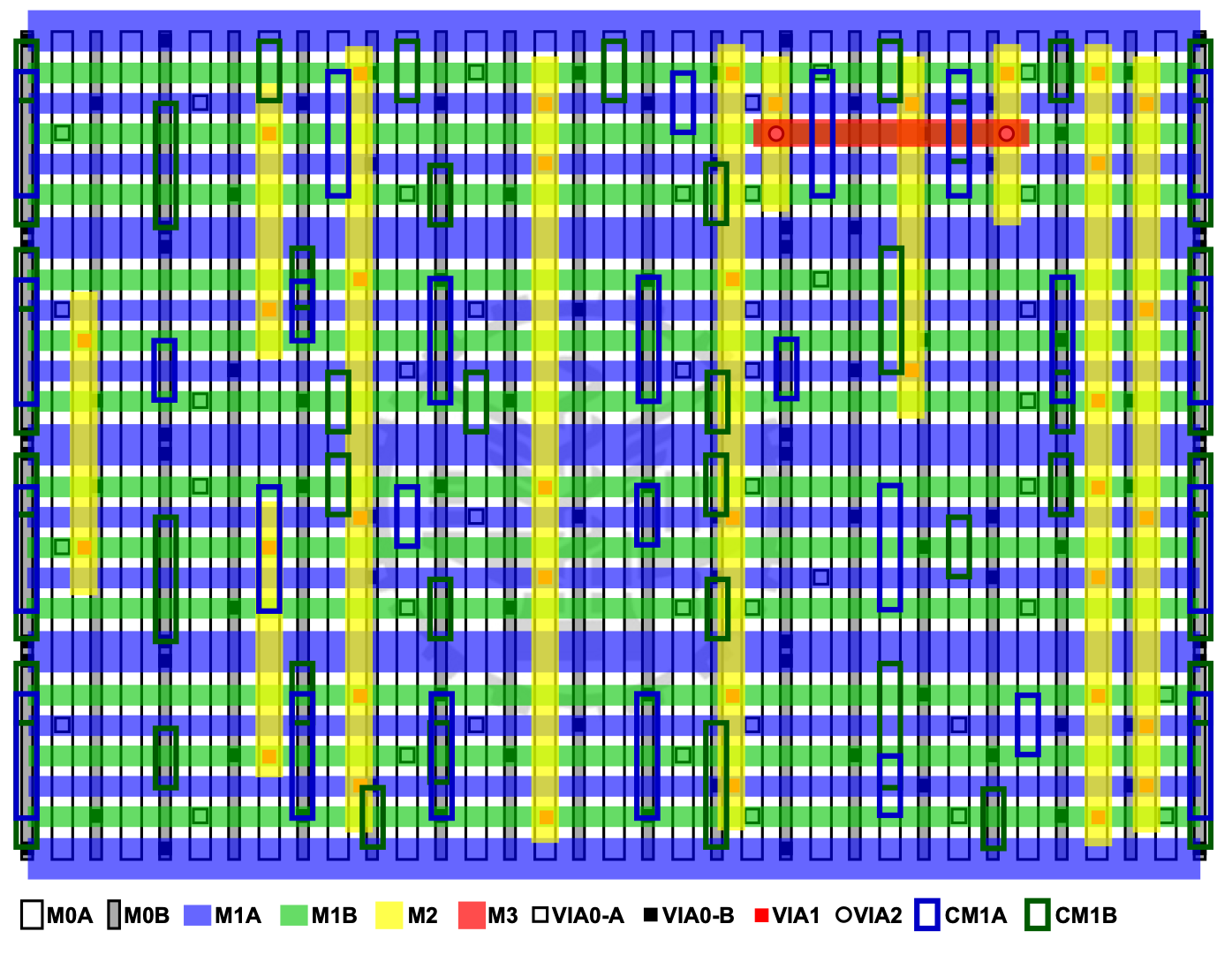
AutoCell 自動生成的 8 位元多位元正反器(MB8FF_X1),四排高。出處:作者博士論文 Fig. 4.1;點圖放大。8-bit multi-bit flip-flop (MB8FF_X1), four rows tall, generated by AutoCell. Source: author's Ph.D. dissertation, Fig. 4.1; click to enlarge.
01 · The Engineering Challenge
難的不是畫出 layout,而是同時滿足所有設計規則The hard part isn't drawing a layout. It's satisfying every rule at once.
Gold marks my core research; teal marks co-authored timing work. This is cell-library creation — not a full RTL-to-GDS implementation flow.
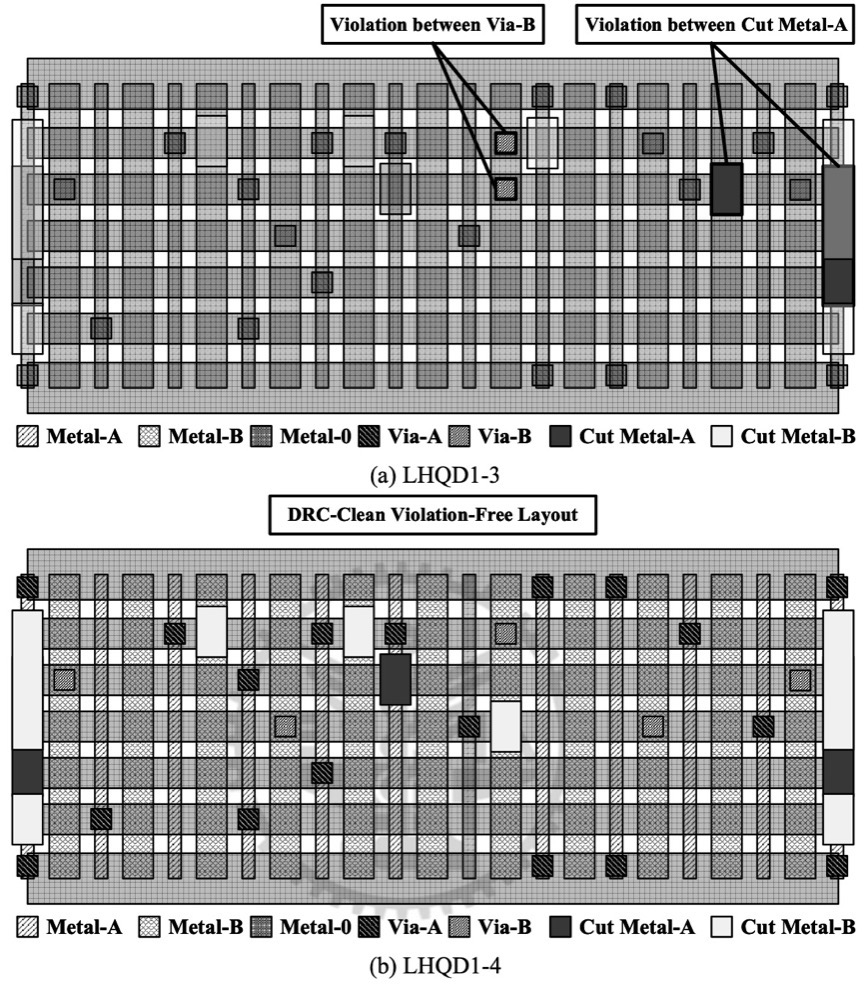
同一個 cell 的兩個版本:上方有 via 與 cut metal 違規,下方才是能製造的 DRC-clean layout。出處:作者博士論文 Fig. 3.2。Two versions of one cell: the top has via and cut-metal violations; only the bottom is a manufacturable, DRC-clean layout. Source: author's Ph.D. dissertation, Fig. 3.2.
違規牽涉多個物件的相對位置。圖中上方的 layout 有兩處違規:一處在兩個 via 之間,一處在兩段 cut metal 之間,不是單一線寬或間距的問題。
Violations involve the relative positions of several objects. In the top layout, one violation sits between two vias and the other between two cut metals — not a single width or spacing check.
規則難以逐條寫死。修好一處常在別處產生新違規,組合多到無法事先列舉。
Rules resist hard-coding. Fixing one violation often creates another, and the combinations are too many to enumerate up front.
每代製程都會變。寫死的規則換製程就要重寫,設計師也得重新讀完規則手冊。
Every node changes them. Hard-coded rules must be rewritten per node, and designers must re-read the rule manual each time.
02 · My Original Contributions
From Rule Learning to Scalable Cell Generation.
從隱式規則學習,到可擴展的元件自動生成。這兩代框架由我提出並實作。
From implicit rule learning to scalable cell generation — two generations of frameworks I proposed and built.
01
ACLG
IEEE TVLSI 2022 · DATE 2021第一作者FIRST AUTHOR
Problem
先進製程的複雜設計規則難以逐條手動編碼,也難以隨製程更新。
Complex advanced-node design rules are hard to encode by hand and to maintain across process updates.
Don't encode the rules — learn them. Learn geometry from existing legal layouts, learn rules from layout patterns, and add constraints only for violations actually encountered.
Fixed 100% of design-rule violations on 13 benchmark cells in a finFET-EUV process. Replacing the commercial DRC tool inside the loop with the learned rule model cut iterations per legal layout from 4.69 to 3.31 (−30%) and ran 2.57× faster on average.
Its limit drove the next generation: of 863 cells in the target library, 427 were generated and passed commercial DRC/LVS; the rest were blocked by the ILP routing scheme.
技術細節:四個階段與三種學習Technical details: four stages, three kinds of learning
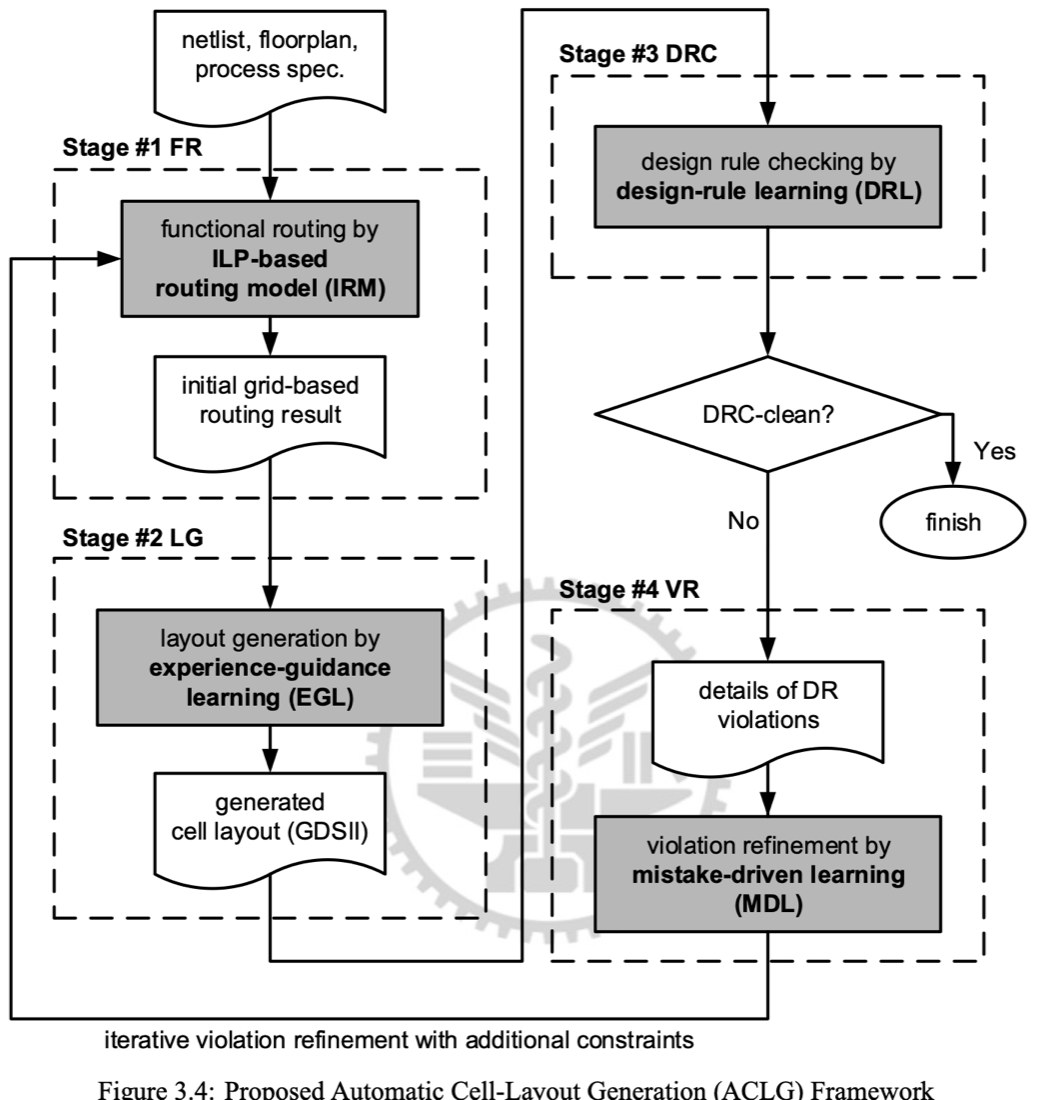
功能繞線(IRM):以 ILP 繞線模型產生初始的格點繞線。
經驗引導學習(EGL):從元件庫中既有的合法 layout 學習目標金屬的幾何行為,正確擺放 via、cut metal 等連接邊界。
DATE 2021 版本是前身:當時依商用 DRC 工具回報的違規加約束(CDL);TVLSI 版改用學出的 DRL 模型,才帶來上述迭代與時間的改善。
Functional routing (IRM): an ILP routing model produces an initial grid-based route.
Experience-guidance learning (EGL): learns the geometry of target metals from existing legal layouts in the library and places connection boundaries such as vias and cut metals.
Design-rule learning (DRL): a decision tree trained on legal library patterns plus artificial failing patterns labeled by a commercial DRC tool; it replaces the DRC tool inside the loop.
Mistake-driven learning (MDL): adds routing constraints for the violations DRL reports and refines iteratively. The commercial DRC tool runs once at the end to guarantee manufacturability.
The DATE 2021 version was the precursor: it added constraints from violations reported by the DRC tool (CDL). The TVLSI version's learned DRL model produced the iteration and runtime gains above.
On a commercial 5nm node, 900+ combinational cells (single- and multi-row) from a commercial library were generated in about 7 minutes with zero DRC/LVS violations. On a 132-cell benchmark, design-rule masking sped up generation by >7,261× on average for core cells (max 27,915×) and >4,081× on average for MBFF (max 16,166×); without masking most cells did not finish within two days, so these are lower bounds. MBFFs up to four rows were generated with a 100% success rate.
My role
博士論文研究,提出並實作。
Ph.D. dissertation research; proposed and built it.
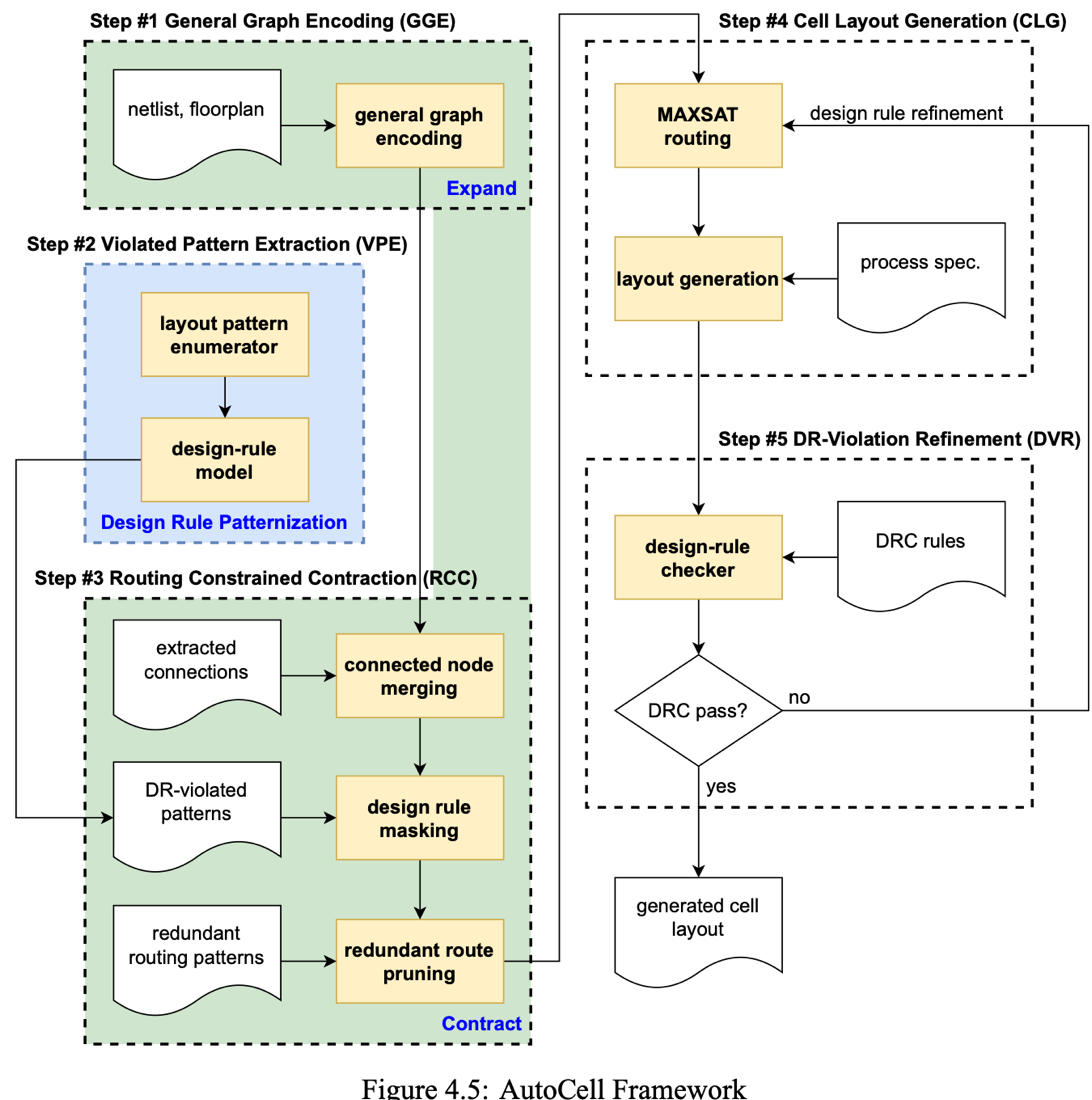
技術細節:框架五步驟與原始流程圖Technical details: five steps and the original flowchart
一般圖編碼(GGE):把所有可能的端點、金屬、via、cut metal 位置編碼成圖,展開完整的解空間。
違規圖樣萃取(VPE,設計規則樣式化):以窮舉圖樣產生器加上設計規則模型,把文字規則轉成違規圖樣。
繞線約束收縮(RCC):連通節點合併、設計規則遮罩、冗餘路徑剪枝,大幅縮小繞線解空間。
元件 layout 生成(CLG):以 MaxSAT 繞線並產生 layout。
設計規則違規修正(DVR):以 DRC 檢查,未通過就回饋修正後重新求解。
General graph encoding (GGE): encodes every possible location of terminals, metals, vias and cut metals, expanding the full solution space.
Violated pattern extraction (VPE, design-rule patternization): an exhaustive pattern generator plus the design-rule model turns written rules into violation patterns.
Routing-constrained contraction (RCC): connected-node merging, design-rule masking and redundant-route pruning shrink the routing space.
Cell layout generation (CLG): MaxSAT routing produces the layout.
Design-rule violation refinement (DVR): a DRC check; failures feed refinements back for re-solving.
AutoCell 框架,圖中標示 Expand、Design Rule Patternization、Contract 三段。出處:作者博士論文 Fig. 4.5。The AutoCell framework, with its Expand, Design Rule Patternization and Contract stages marked. Source: author's Ph.D. dissertation, Fig. 4.5.
產業背景:2019–2022 年我在聯發科擔任 EDA 工程師,研究 AI 元件 layout 生成,當時開發的方法與流程已導入聯發科產線;ACLG 研究部分由聯發科支持。Industry context: from 2019 to 2022 I was an EDA engineer at MediaTek working on AI cell layout generation; the methods and flow I developed there were adopted in MediaTek's production line. The ACLG research was supported in part by MediaTek.
03 · Research Extensions
Co-Authored Extensions and Related Work
以下為共同作者研究,實作由學生或聯發科工程師主導;我的角色逐項標示。
Co-authored work; implementation was led by students or MediaTek engineers. My role is stated per paper.
PPA-directed routing of multi-height cells with anytime MaxSAT and constraint learning. 5.5% lower power on 33 MBFF designs beyond 4nm; delivery time vs. manual layout cut from days to hours (21.6×).
共同作者CO-AUTHOR 聯發科主導,11 位作者中第 10 位MediaTek-led; 10th of 11 authors DOI ↗
Placement-routing co-optimization: AllSAT enumerates only legal, routable placements, then Monte Carlo Tree Search explores them. On 450 low-drive cells of a 4nm FinFET library, routability 1.1% → 62.7%, 62.2× faster than brute force at 0.2% wirelength cost.
共同作者 · 指導CO-AUTHOR · MENTOR 8 位作者中第 4 位;指導學生、討論問題與方向4th of 8; mentored the student on problem framing & direction DOI ↗
An LDE-aware model ranks layout candidates so only the top few need full evaluation. Found the optimal layout for all 10 benchmark cells of a sub-5nm industrial library, 348× faster on average than exhaustive evaluation (5–1,080×).
第二作者 · 指導2ND AUTHOR · MENTOR 6 位作者中第 2 位;指導學生、討論問題與方向2nd of 6; mentored the student on problem framing & direction DOI ↗
Beyond the library: mine recurring logic subgraphs after synthesis and remap them to non-overlapping hypercells chosen by MaxSAT. On the EPFL suite, 12.2% (FreePDK45) and 7.4% (ASAP7) average area reduction; 380× faster than the prior state of the art at ASAP7.
共同作者 · 指導CO-AUTHOR · MENTOR 6 位作者中第 4 位;指導學生、討論問題與方向4th of 6; mentored the student on problem framing & direction DOI ↗
Simulate a few anchor corners, learn the residual over a physics-consistent reference with graph neural networks, and let uncertainty pick the next corner. TSMC 16nm, 12 anchors per arc: 1.67% MAPE at the cell level; in a separate validation on 14 ISCAS'89 circuits, 98.7% fewer SPICE runs and 37.2× end to end.
共同作者 · 報告者CO-AUTHOR · PRESENTER 4 位作者中第 3 位;方法與方向討論、會議報告3rd of 4; method & direction discussions, presented at DAC DOI ↗
ACLG on a finFET-EUV process and AutoCell on a commercial 5nm node; the extensions on the processes and libraries stated in each paper (4nm, sub-5nm, 16nm, ASAP7, FreePDK45).
Nanosheet and forksheet layouts remain single-tier and row-based, so the methods may carry over — but the abstraction, rules and constraints must be re-validated.
REFORMULATE
需要重新定義
Requires reformulation
CFET 把 n、p 上下堆疊,layout 變成多層加上跨層連線,問題本身需要重新定義。
CFET stacks n over p, turning a layout into tiers with inter-tier connections; the problem itself must be redefined.
後兩欄是我對方法適用範圍的判斷,尚未以實驗驗證。The last two columns are my assessment of where the methods apply; they have not been tested experimentally.
From Design Automation to Agentic Systems.
從設計規則學習、約束最佳化,到可靠的 AI 工具執行,共通點是把複雜任務做成輸出可以被檢查的自動化系統。
From design-rule learning and constrained optimization to reliable AI tool execution, the common thread is turning complex tasks into automated systems whose output can be checked.
Decompose complex problems. Learn what can be learned. Verify what must be correct.